
A lens is usually a piece of glass with a shaped surface. A geodesic lens is a piece of geometry. The two ideas meet through a change of variables: under the right conditions, the rays inside a gradient-index medium are exactly the geodesics on a curved surface. The equivalence is not an analogy. It is an identity between two metrics.1
Fermat's principle is a metric
In a medium with refractive index $n(\mathbf{r})$, Fermat's principle says that a ray makes the optical path
\[ S=\int n(\mathbf{r})\,ds \]
stationary, where $ds$ is the Euclidean arc length. The resulting ray equation is
\[ \frac{d}{ds}\left(n\frac{d\mathbf{r}}{ds}\right)=\nabla n. \]
There is a more geometric way to say the same thing. The optical metric is $g_{ij}=n^{2}\delta_{ij}$, and the rays are its geodesics. A medium is a geometry in disguise. This is the point of view that transformation optics takes seriously: change coordinates, and the geometry changes; Maxwell's equations do not. The material parameters absorb the Jacobian.
A surface with the same metric
Now consider a surface of revolution generated by a profile $z(\rho)$, with coordinates $(\rho,\varphi)$. Its metric is
\[ ds_{\Sigma}^{2}=\left[1+\left(\frac{dz}{d\rho}\right)^{2}\right]d\rho^{2}+\rho^{2}d\varphi^{2}. \]
We want this to be the optical metric of a radially symmetric medium, $n^{2}(r)\left(dr^{2}+r^{2}d\varphi^{2}\right)$. Matching the two terms gives three relations:
\[ \rho=n(r)\,r,\qquad ds=n(r)\,dr, \]
\[ dz^{2}=ds^{2}-d\rho^{2}. \]
The first relation defines the projected radius. The second identifies optical arc length with arc length on the surface. The third fixes the height. Differentiating $\rho=nr$ gives $d\rho/dr=n+rn'$, so the first two relations imply
\[ s'(\rho)\,(n+rn')=n,\qquad s'(\rho)\equiv\frac{ds}{d\rho}. \]
Once $s'(\rho)$ is known, the surface follows by quadrature:
\[ z(\rho)=\int_{0}^{\rho}\sqrt{s'(\xi)^{2}-1}\;d\xi. \]
A real surface requires $s'(\rho)\ge1$. Where $s'=1$ the sheet is locally flat; where $s'\to\infty$ its tangent turns vertical, which is what happens at the rim of every lens below. Those are geometric conditions, not fabrication details — although they become fabrication details very quickly.
The Luneburg lens is Rinehart's surface
The Luneburg profile is the cleanest example. It is
\[ n^{2}(r)=2-r^{2},\qquad 0\le r\le1. \]
The projected radius is $\rho=r\sqrt{2-r^{2}}$, so $\rho^{2}=1-(1-r^{2})^{2}$ and $1-r^{2}=\sqrt{1-\rho^{2}}$. The master identity then gives
\[ s'(\rho)=\frac{2-r^{2}}{2\,(1-r^{2})}=\frac12\left(1+\frac{1}{\sqrt{1-\rho^{2}}}\right), \]
which integrates to
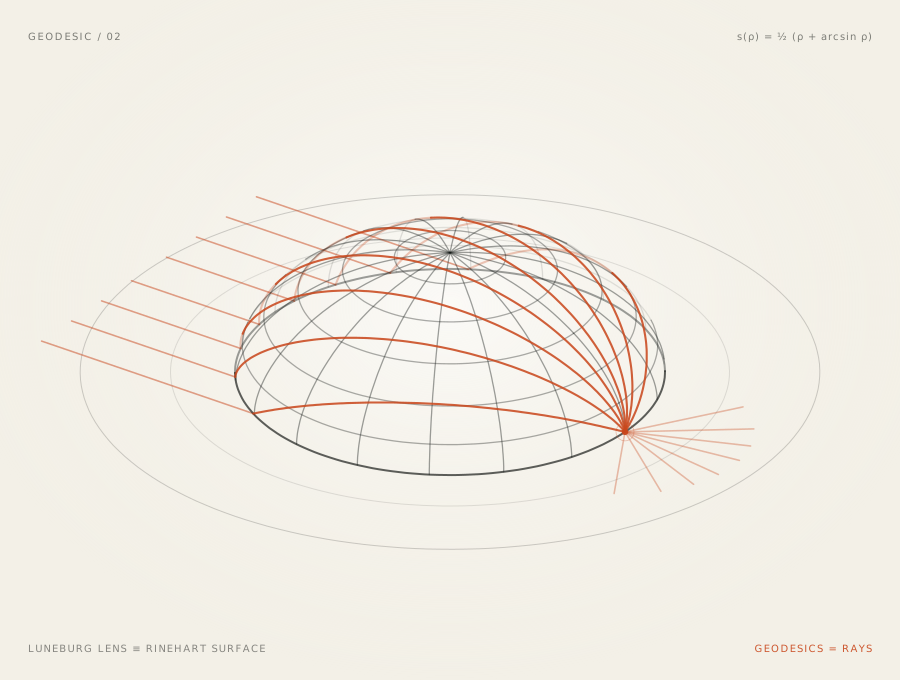
\[ s(\rho)=\tfrac12\left(\rho+\arcsin\rho\right). \]
This is the surface Rinehart found in 1948 as a waveguide lens for scanning radar. Its meridian is the arithmetic mean of a flat disc, $s=\rho$, and a hemisphere, $s=\arcsin\rho$: a dome that is flat at the apex, meets the plane with a vertical tangent, and stands $0.63$ lens radii high. A parallel bundle of rays arriving in the plane climbs the dome as a family of geodesics, and every one of them leaves through the same point on the far side of the rim. What looks like a statement about a carefully graded refractive index is, after the change of variables, a statement about one curved sheet.
Where the sphere belongs
It is tempting to stop one line early. Writing $z=1-r^{2}$ turns $\rho^{2}=1-(1-r^{2})^{2}$ into $\rho^{2}+z^{2}=1$, which looks like a unit sphere, and the first version of this note said so. It is a coincidence in $\rho(r)$ alone. That choice of $z$ gives $d\rho^{2}+dz^{2}=4\,dr^{2}/(2-r^{2})$, not $n^{2}dr^{2}$: the radii match and the arc lengths do not. An invariant settles it. The optical metric $n^{2}\left(dr^{2}+r^{2}d\varphi^{2}\right)$ has Gaussian curvature
\[ K=-\frac{1}{n^{2}}\,\nabla^{2}\ln n, \]
which for the Luneburg lens is $K=4/(2-r^{2})^{3}$. It rises from $\tfrac12$ at the centre to $4$ at the rim; a sphere has constant curvature. The profile that does have $K=1$ is Maxwell's fish-eye, $n=2/(1+r^{2})$. Its equivalent surface is the unit sphere, the map between them is stereographic projection, its rays are great circles, and every point is imaged at its antipode.2
What the Morse family adds
The Luneburg lens is one point in a family. The Morse-type profile
\[ n^{2}(r)=2r^{-2+1/B}-r^{-2+2/B},\qquad 0<r\le1, \]
reduces to Luneburg at $B=\tfrac12$ and to Eaton at $B=1$. Intermediate values interpolate between a focusing lens and a retroreflector. In my BSc thesis I showed that the conformal Morse lens is the $(A=B,\,C=1)$ slice of Cornbleet's general family, with the parameter correspondence $a=-1/B$, and constructed the equivalent surfaces for the intermediate profiles. For the whole family the quadrature closes in the same way:
\[ s(\rho)=B\left(\rho+\arcsin\rho\right). \]
The existence condition $s'\ge1$ does the sorting. At the apex $s'(0)=2B$, so a real surface exists exactly for $B\ge\tfrac12$, and the Luneburg lens is the borderline case with a smooth top. For $B>\tfrac12$ the index diverges at the origin, but gently: $n\sim r^{-1+1/(2B)}$, which is $r^{-1/2}$ for Eaton. The optical path to the centre is therefore finite ($1+\pi/2$ lens radii for Eaton) and the surface stays closed. What the divergence leaves behind is a cone: the apex has half-angle $\arcsin(1/2B)$, which is $30^{\circ}$ at the Eaton end. A geodesic that passes a cone point is turned, and that turning is the retroreflection.3 The Morse family is interesting precisely because it lets us watch a smooth dome sharpen into a cone.
What the equivalence does not do
It does not solve the wave problem. The metric equivalence is an identity between ray equations; it says nothing about polarisation, Fresnel reflection, or the diffraction limit of the resulting aperture. A surface that reproduces the rays of a lens can still scatter differently at the rim.
It also does not make the lens easy to build. A smooth dome is forgiving; a cone point is not. The interesting experimental question is not “does a surface exist?” but “how much figure error can it tolerate before the caustic stops being useful?”4
Why I keep returning to it
The equivalence is a good antidote to the habit of thinking of a lens as an object. A lens is a relationship between a metric and a family of curves. Sometimes that relationship is realised by glass; sometimes by a metasurface; sometimes by a surface of revolution that exists only in a ray tracer. The mathematics does not care which.
It is also a useful reminder that “transformation optics” and “geodesic lenses” are the same idea seen from two directions: one starts from a coordinate change and asks what material realises it; the other starts from a surface and asks what rays it produces. The thesis lives in the second direction. The next project may need both.
The full derivation, including the parameter correspondence and the ray-tracing checks, is in the thesis.
Revision history
- 10 Nov 2026 — Corrected the central example. The first version claimed that the Luneburg lens is equivalent to a unit sphere, and that the Eaton surface cannot close because the optical path to the origin diverges. Both claims were wrong. The Luneburg surface is Rinehart's, $s=\tfrac12(\rho+\arcsin\rho)$; the sphere belongs to Maxwell's fish-eye; the Eaton path is finite and its surface is closed, with a conical apex. Fig. 2 was recomputed, and the Šarbort–Tyc reference now carries the right article number.
- 02 Nov 2026 — First published.
References
- R. K. Luneburg, Mathematical Theory of Optics. Brown University Press, 1944.
- R. F. Rinehart, “A solution of the problem of rapid scanning for radar antennae,” J. Appl. Phys. 19, 860–862 (1948). doi
- M. Šarbort and T. Tyc, “Spherical media and geodesic lenses in geometrical optics,” J. Opt. 14, 075705 (2012). doi
- U. Leonhardt, “Optical conformal mapping,” Science 312, 1777–1780 (2006). doi
- H. Chen, “The Morse lens,” arXiv:2002.03884 (2020). arXiv
- S. Cornbleet, Microwave and Geometrical Optics. Academic Press, 1994.