Figure: parallel rays of light enter a Luneburg lens and converge at a single point on the opposite rim of the lens.
Zheng Xiangsheng — Physics MSc
Light follows
geometry
I study transformation optics, geodesic lenses and quantum optics — how a change of geometry becomes a change of light.
The through-line
A lens is a piece of geometry. A coordinate transformation is a material. Change the space, and light obeys.
I am a physics MSc student at Western University, working where transformation optics meets the bench: geodesic lenses, conformal mapping, and single-photon interference.
My BSc thesis at Xiamen University Malaysia asked a narrow question — what surface is equivalent to a Morse lens? — and answered it with a metric, a quadrature, and a ray tracer.
More about me02 Research
Three ways to bend a ray.
The same question at three scales: how does geometry decide the path of light? Walk through the lab
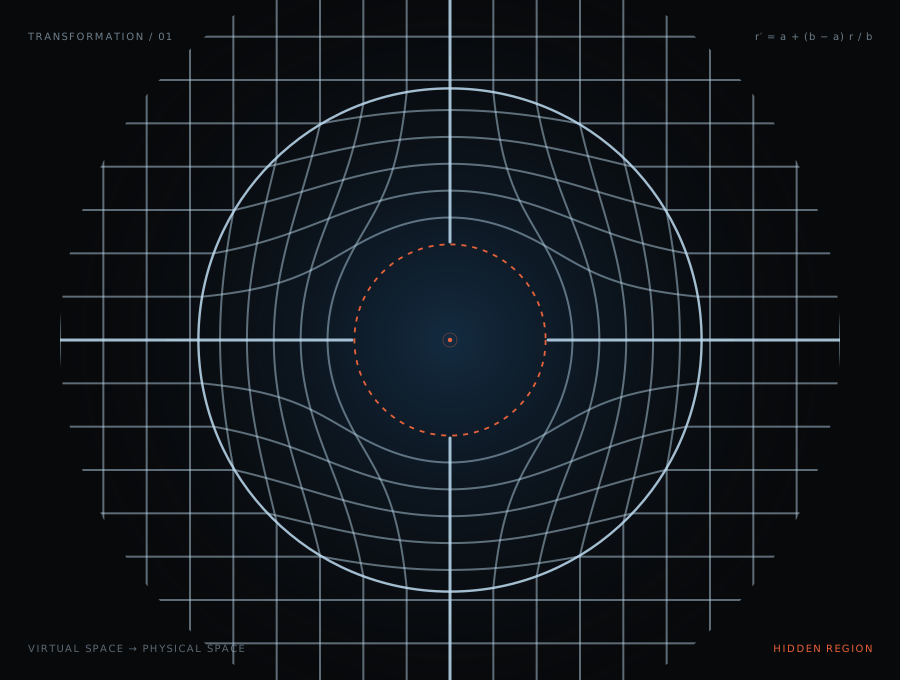
Transformation optics
Coordinate transformations rewritten as material parameters — from Fermat's principle to the cloak.
Enter the field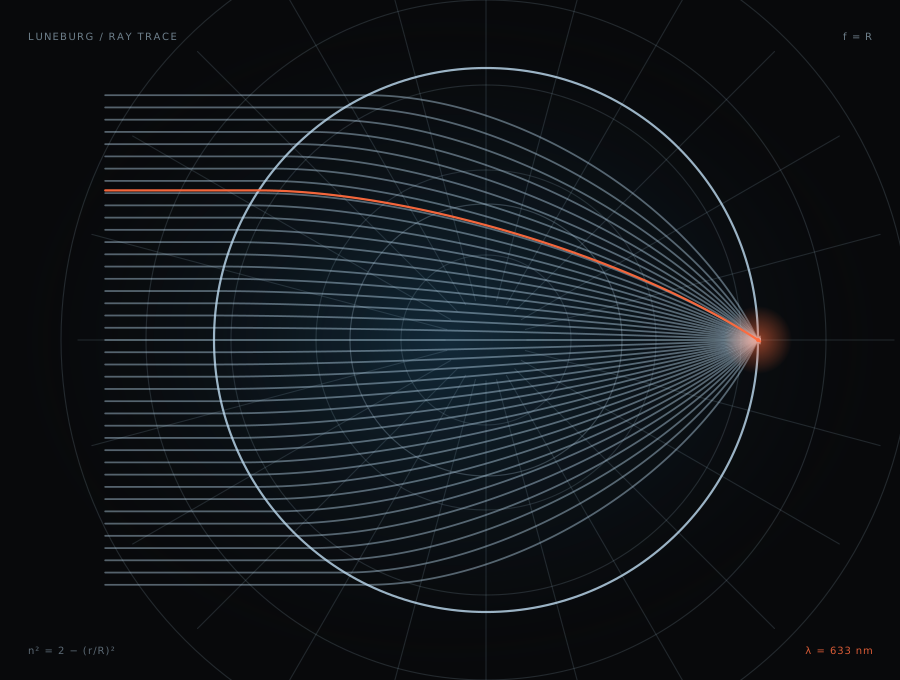
Geodesic lenses
Morse, Luneburg and Eaton lenses as equivalent surfaces, traced ray by ray — and turned into geometry.
Enter the field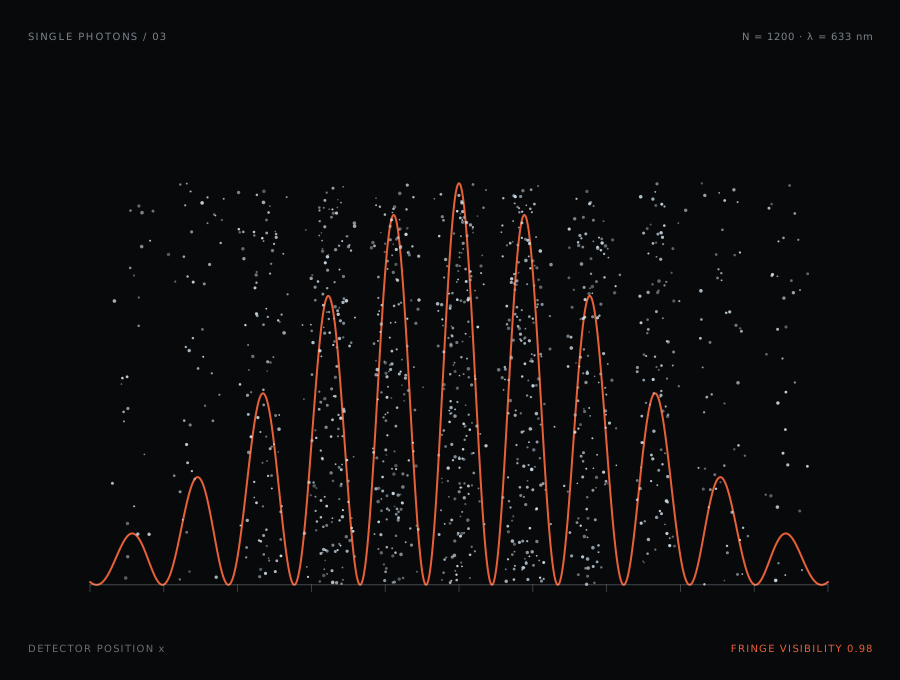
Quantum optics
Single-photon interference and wave–particle duality, approached one detection at a time.
Enter the field03 Selected work
The Morse lens, traced to its surface.
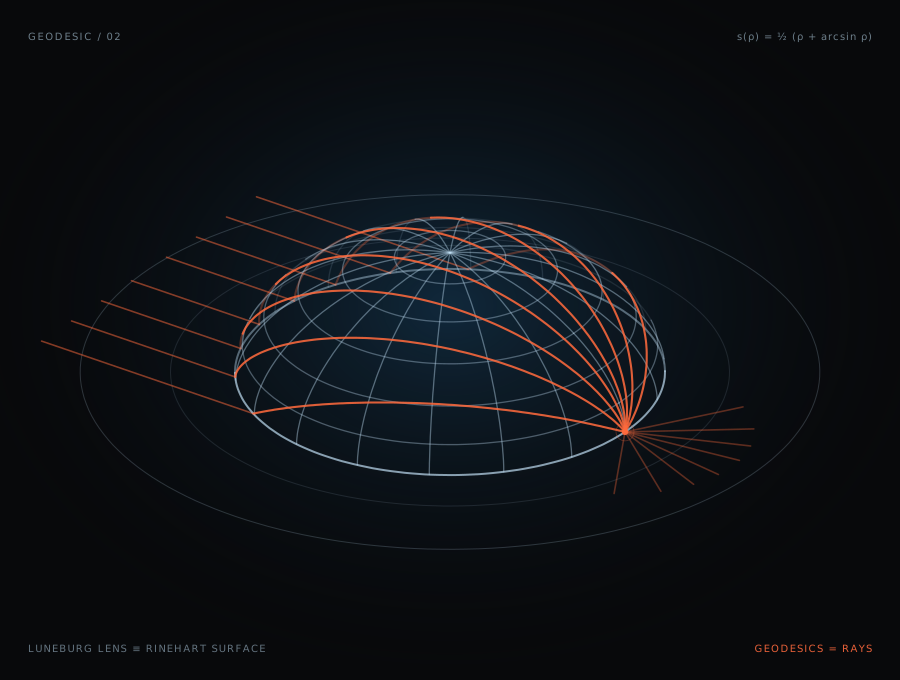
A BSc thesis that proves the conformal Morse lens is a slice of Cornbleet's family, constructs its equivalent geodesic surface, and checks the geometry ray by ray.
04 Field notes
Working notes, kept honest.
Short, reproducible notes on optics and numerical geometry. Assumptions stated, code included, figures computed. All notes
Why a lens is a surface
The metric equivalence that turns a gradient-index problem into curved geometry — and why the Luneburg lens is a dome, not a sphere.
Tracing a ray through the Morse lens
Four equations, a step size, and a convergence check: what it takes to trust a numerically traced ray.
One photon at a time
Interference without a second photon, and what a which-path detector does to the fringes.
05 Now
At the moment.
06 The matrix
One practice, three sites.
A person is not one page. This is the Index; the Lab and the Record live next door. How the matrix fits together
The person, now.
Research, field notes, selected work and what I am doing at the moment.
02 / LabThe research, in depth.
Instruments, papers and the computational notebook — where a figure can be rerun.
03 / RecordThe formal record.
CV, education, publications and the dossier for committees and collaborators.